Choosing the breed
Miniature Bull Terrier Temperament: An Honest Guide Before You Commit
Funny, affectionate, stubborn and busy. What that means with children, other dogs, a flat and a working day, and who should choose a different breed.
In short: the miniature bull terrier is a people-loving, playful and obstinate terrier. The FCI standard describes it as "courageous, full of spirit, with a fun loving attitude", "of even temperament" and "particularly good with people". It can live well with children and in a flat, with supervision and daily exercise. It needs patient, consistent training, and it does not cope well with being left alone for long days.
We breed miniature bull terriers, so we have every reason to tell you they are perfect. They are not perfect for everyone. The breed clubs say the same thing, and we quote them below so you can hear it from people who do not sell puppies.
If you are still deciding between the mini and the larger breed, start with our comparison of the mini vs standard bull terrier. The temperament described in both standards is identical, so most of this guide applies to both.
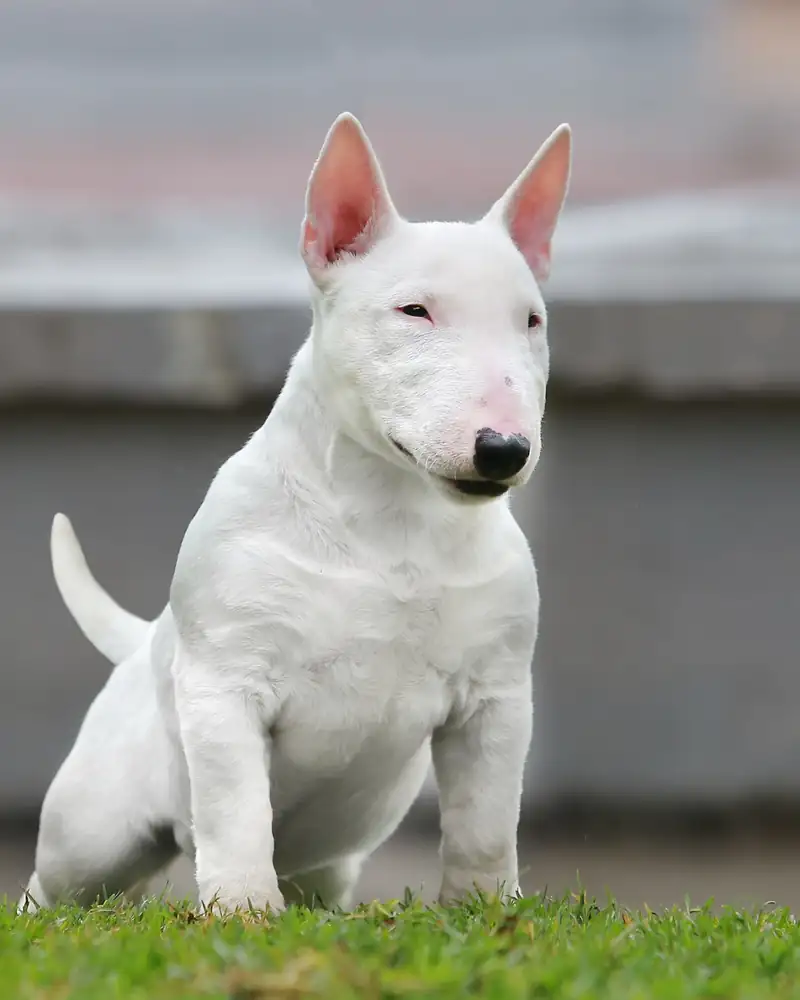
The personality in one paragraph
The official standards all describe the same character. The FCI and the Royal Kennel Club: "Courageous, full of spirit, with a fun loving attitude. Of even temperament and amenable to discipline. Although obstinate is particularly good with people." The AKC standard asks for a temperament "full of fire and courageous, but even and amenable to discipline". The AKC's own breed description is less formal: "full of mischief and high spirits", with "terrier fire and fearlessness".
The UK Miniature Bull Terrier Club adds a detail that owners recognise: the mini "can be a sensitive soul and needs an understanding home, preferably with a sofa". The US club (MBTCA) says Minis are "bright, very busy, strong in body and mind, yet emotionally sensitive and noted for being the comedian of the dog world".
Put together: a clownish, affectionate dog that wants to be involved in everything, reacts badly to harshness, and will test whether a rule really is a rule.
What the AKC ratings say
The AKC scores every breed from 1 to 5 on a set of traits. These are breed generalisations, not a forecast for one dog, but they are a useful starting point.
| Trait (AKC) | Mini bull score | What it means in daily life |
|---|---|---|
| Affectionate with family | 5 / 5 | Wants to be close to you, on the sofa if allowed. |
| Good with young children | 3 / 5 | The AKC's "with supervision" level. |
| Good with other dogs | 3 / 5 | Also "with supervision". The standard bull terrier scores 1. |
| Energy level | 4 / 5 | A daily walk plus play and training, every day. |
| Trainability | 3 / 5 | Learns fast, but decides whether it is worth it. |
| Mental stimulation needs | 4 / 5 | A bored mini invents its own jobs. |
| Barking level | 5 / 5 | The AKC tags the breed as "frequent" barkers. Relevant in a flat. |
| Adaptability | 4 / 5 | Adjusts well to different homes, including smaller ones. |
Are miniature bull terriers good with children?
They can be very good with children, and the breed clubs agree on the condition: supervision. The UK club says there is "no reason why a Miniature Bull Terrier cannot live with children of all ages, as long as the parents/carers supervise both the puppy and the children's activities together". It also says minis "love being around children of all ages" but "are boisterous at times".
The MBTCA's breed leaflet names two situations that need "supervision/avoidance": children or people roughhousing, and interactions with other dogs.
In practice, the risk with a mini and a small child is rarely bad temper. It is a solid, strong, excitable dog that bumps, jumps and grabs toys in play. A few house rules make the difference:
- No rough games that wind the dog up (wrestling, chasing the dog around the house).
- The dog has a crate or bed where children do not follow it.
- Young children are never left alone with the dog, however good it is.
- Children learn not to disturb the dog while it eats or sleeps.
- An adult runs the training; children join in once the dog knows the rules.
Are miniature bull terriers aggressive with other dogs?
The standards do not accept aggression: the FCI lists "aggressive or overly shy dogs" as a disqualifying fault. With other dogs, though, the honest answer is "it depends, and plan for it". The AKC rates the mini 3 out of 5 with other dogs, meaning it can work with supervision. The MBTCA leaflet flags dog-to-dog interactions as a situation to supervise, "particularly if one or both are unaltered" (not neutered or spayed).
Some practical points from what the clubs describe:
- Introductions matter. Meet on neutral ground, on lead, and keep the first sessions short.
- Entire dogs need more care. That is the case the MBTCA singles out. If you already have a dog, tell your breeder its sex, age, whether it is neutered and how it behaves with other dogs before a puppy is chosen.
- Terrier drive does not switch off at the park. A mini that has not been taught to ignore other dogs will want to go and greet, or argue.
Cats and small pets
The AKC's history of the breed says the mini was developed as an above-ground ratter, and "the ratter instinct and a protective streak remain". That does not mean a mini cannot live with a cat. Many do, especially when they grow up together. It does mean you should not trust a mini alone with rabbits, guinea pigs or rodents, and that a cat needs escape routes the dog cannot follow.
Can a mini bull live in an apartment?
Yes, if the dog's needs are met outside it. The Royal Kennel Club lists the mini as suitable for a "small house" with a "small/ medium garden", with "up to 1 hour per day" of exercise. The AKC gives it 4 out of 5 for adaptability.
The three things that decide whether a flat works:
Exercise
An adult mini needs daily walks plus play and training. The UK club says they "will walk for hours, run with or jog with you" and enjoy agility, flyball and trick training. Puppies are different: the AKC warns that Minis "can be prone to 'sudden lameness'" while growing and that puppy exercise "should be kept at a minimum", with no jumping from heights. The UK club's rule of thumb is to add about five minutes of activity per month of age, so roughly 10 minutes a day at eight weeks and 30 at six months.
Noise
The AKC scores the mini 5 out of 5 for barking. That does not mean constant barking in every home, but neighbours through a thin wall will notice a bored or under-exercised mini. Enough activity and a predictable routine help more than anything else.
Being left alone
This is the one we would think hardest about. The UK club is direct: minis "do not do well in situations where they are left alone for 8 hours a day where they will become bored and destructive". The MBTCA says they "are not to be left alone in the yard or home, as a rule" and that "too much time alone may contribute to neurotic, destructive behaviors". If everyone in the house works full days away, plan for a dog walker, daycare or a family member before you plan for a puppy.
Training: stubbornness, socialisation and what works
Every source describes the same mix: clever and quick to learn, but independent. The AKC says Minis "require a trainer with a firm hand and a gentle voice, as well as lots of patience and a great sense of humor", and that many owners use clicker training. The MBTCA says they "respond well to food and toy rewards, great consistency, and firm guidelines, but not to heavy-handed correction", and that it is "difficult if not impossible to force them to do anything".
What that looks like in practice:
- Short sessions. A few minutes, several times a day, ending while the dog still wants more. The MBTCA notes short attention spans "at any age".
- Rewards, not force. Food and toys work; shouting and physical corrections make a sensitive, stubborn dog dig in.
- The same rules from everyone. If one person allows the sofa and another does not, the mini will learn the loophole.
- Management while young. Baby gates, a pen and a crate, as the MBTCA suggests, until the dog is "mature and educated".
- A class. Puppy class first, then continued training through adolescence. The MBTCA suggests the AKC Canine Good Citizen test as a goal.
The socialisation window
The American Veterinary Society of Animal Behavior (AVSAB) says the most important time for puppy socialisation is "the first three months of life", and that puppies can start socialisation classes as early as 7-8 weeks, once they have had at least one set of vaccines at least 7 days before the first class and a first deworming. The UK club says the same for minis: start from eight weeks, with as many new sights, sounds, people and places as you can manage safely.
If you are buying from abroad, part of that window happens at the breeder's, and sometimes more than you might expect, because some countries set a minimum age for importing a puppy. Ask any breeder, including us, exactly how the puppies are socialised before they leave: people, sounds, handling, car journeys, the travel crate.
Tail chasing and compulsive behaviour
One breed-specific point: the MBTCA lists tail chasing among the breed's main health problems, noting it "may be a sign of neurological disorders that may/may not respond to behavioral modifications". If a mini starts spinning or chasing its tail repeatedly, treat it as something to raise with a vet, not a funny habit. Our guide to common health problems covers the conditions that can be screened for in the parents.
Who should not get a mini bull
The MBTCA's leaflet starts its section on breed character with "The Miniature Bull Terrier is not for everyone", and advises anyone unwilling to train the dog properly to "find another breed". We agree. A mini is probably the wrong choice if:
- The dog would be alone most of the working day, most days.
- You want a dog that obeys because it is told to. Minis cooperate when they think it is worth it.
- You cannot commit to puppy classes and daily training in the first year.
- You keep small pets such as rabbits or rodents that the dog would share space with.
- You need a dog that reliably mixes with any dog at the park.
- Your neighbours or building rules make barking a real problem.
- The budget has no room for training classes, insurance and vet checks. Our guide to what a puppy really costs covers the full picture.
And the good news for everyone else: if you want a small, sturdy, affectionate dog with a sense of humour, and you can give it company and some structure, the mini is a joy to live with. The Royal Kennel Club lists it as a vulnerable native breed in the UK, so there are not many of them around.
How we match a puppy to your home at forty days
Our process is on the home page, and we will not promise more here than we do there. Puppies are chosen at forty days, in waiting-list order. By then, temperaments are readable, and we tell you which puppy suits your home, even when that costs us the sale.
That only works if we know your home. Before the choice, it helps to tell us:
- Who lives in the house, including the ages of any children.
- Other animals: species, sex, age, whether neutered, and how they are with dogs.
- Flat or house, garden or not, stairs.
- How many hours a day the dog would be alone.
- What you want to do together: walks, running, sports, a quiet companion.
- Any previous experience with terriers or bull breeds.
This is also why the first step is a live video call. You see the kennel and the mother, and we get to know you before anything is agreed.
Not sure yet?
Tell us about your home on a video call
We will say honestly whether a mini bull fits. No payment at this step, and no obligation to join the waiting list afterwards.
Book a video callFAQ
Are miniature bull terriers good with kids?
They can be. The UK Miniature Bull Terrier Club says they can live with children of all ages as long as adults supervise the puppy and the children together. The AKC rates the breed 3 out of 5 for young children, its "with supervision" level. Avoid rough games that over-excite the dog.
Are miniature bull terriers aggressive?
Aggression is a disqualifying fault in the FCI standard, which describes the breed as of even temperament and particularly good with people. With other dogs they need supervision: the AKC rates them 3 out of 5, and the MBTCA advises care especially when one or both dogs are not neutered.
Can a miniature bull terrier live in an apartment?
Yes, with daily exercise and company. The Royal Kennel Club lists the breed for a small house with up to an hour of exercise a day. Bear in mind the AKC rates barking at 5 out of 5, and the breed clubs warn against leaving minis alone for long days.
Is a miniature bull terrier good for a first-time owner?
It can be, if you are ready to train consistently. The MBTCA says the breed is "not for everyone" and needs a firm, consistent, reward-based approach, puppy classes and early socialisation. First-time owners who commit to that time do well; those who want an easy dog usually do not.
How long can a miniature bull terrier be left alone?
Not for full working days. The UK club says minis do not do well when left alone for 8 hours a day and become bored and destructive. The MBTCA advises that they should not be left alone as a rule, and crated or in a run when unsupervised.
Do miniature bull terriers get along with cats?
Many do, especially when raised together. The AKC notes the breed's ratter instinct remains, so introductions need care, the cat needs escape routes, and small pets such as rabbits or rodents should not be left with the dog.
Sources
- FCI, Standard no. 359, Miniature Bull Terrier (PDF)
- Royal Kennel Club, Bull Terrier (Miniature) breed standard and breed information
- AKC, Miniature Bull Terrier breed page (traits, training, exercise, history) and official standard (PDF)
- Miniature Bull Terrier Club of America, breed leaflet (PDF)
- Miniature Bull Terrier Club (UK), Is this the breed for you?
- American Veterinary Society of Animal Behavior, Position statement on puppy socialization (PDF)
General information about the breed, not individual behavioural or veterinary advice. For a specific problem, talk to your vet or a qualified behaviourist.