Choosing the breed
Miniature Bull Terrier Colours: What the Standard Accepts
White or coloured, brindle, red, fawn and tricolour: what the FCI, Kennel Club, AKC and UKC standards say, which "rare" colours to avoid, and what coat colour has to do with hearing.
In short: miniature bull terriers come in two varieties, white and coloured. The FCI standard asks for a pure white coat in whites, with markings on the head allowed. In coloured dogs, colour must predominate: brindle is preferred, and black brindle, red, fawn and tricolour are acceptable. Blue and liver are "highly undesirable".
"Rare" colours such as merle, lilac or chocolate aren't part of the breed. The UK breed club says they are introduced by crossing with other breeds. Whatever the colour, ask for a BAER hearing test: white coats are linked to a higher risk of congenital deafness.
Colour is often the first thing buyers ask us about, and it's the last thing we'd use to choose a puppy. Still, it's worth knowing what's correct for the breed, because colour is also where some sellers cut corners: selling non-standard "exotic" colours at a premium, or skipping the hearing test in white puppies.
This guide quotes the standards directly. We use the British spelling "colours", but US readers will find the same information under miniature bull terrier colors. The colour rules are the same for the standard bull terrier; if you're still deciding between the two breeds, see our comparison of the miniature vs standard bull terrier.
White vs coloured: what FCI 359 says
The miniature bull terrier's international standard is FCI standard no. 359, dated 5 July 2011. Its colour section is short enough to quote in full:
"For White, pure white coat. Skin pigmentation and markings on head not to be penalised. For Coloured, colour predominates; all other things being equal, brindle preferred. Black brindle, red, fawn and tricolour acceptable. Tick markings in white coat undesirable. Blue and liver highly undesirable."
FCI standard no. 359, Miniature Bull Terrier, colour section
Three things follow from that paragraph:
- A "white" mini bull can have colour on its head. A white dog with a brindle or red patch over one eye or ear is still a white. The rule is about the body coat.
- In a coloured dog, colour must dominate. White on the chest, legs, face or collar is normal. A mostly white dog with a few body patches doesn't fit either variety neatly.
- Pink skin showing through a white coat is not a fault. "Skin pigmentation" is explicitly not penalised.
Accepted coloured variants
These are the colours the standards accept, in the order of preference the FCI gives. The UK Miniature Bull Terrier Club's list of approved colours also names the "and white" and "solid" versions of each.
Brindle
Dark stripes over a lighter, usually red or fawn, base. It's the colour the FCI standard names as preferred "all other things being equal", which in practice means it can only decide between two otherwise equal dogs at a show. The UK club lists both brindle and white, and solid brindle.
Black brindle
A brindle where the dark stripes dominate, so the dog looks mostly black with fine lighter striping, often with white markings. Accepted by the FCI and the UK club, and listed by name in the AKC standard.
Red
A reddish-brown coat, typically with white on the face, chest and legs. The UK club lists red and white, and solid red.
Fawn
A lighter, yellowish-tan version of red. The AKC standard allows red and fawn "with or without white and/or smut markings". Smut is a darker overlay, often on the muzzle.
Tricolour
Black and tan with white: typically a black body, tan points on the cheeks, eyebrows and legs, and white on the face and chest. The UK club lists tricolour and "solid tri (black & tan)". The AKC standard lists this as black and tan, with or without white.
White with head markings
Not a coloured variant, but the most common source of confusion. A white mini bull with a brindle, black brindle, black and tan, red or fawn patch on the head is a white, per the UK club's list.
How the four standards compare
The main registries agree on the basics. They differ in wording, and in how strictly they treat colours outside the list.
| Point | FCI (no. 359) | Royal Kennel Club (UK) | AKC (USA) | UKC (USA) |
|---|---|---|---|---|
| Varieties | White, coloured | White, coloured | White, coloured | White, coloured |
| Head markings on whites | Not penalised | Not penalised | Not penalised | Permissible |
| Preferred colour | Brindle | Brindle | Not stated | Brindle |
| Other accepted colours | Black brindle, red, fawn, tricolour | Black brindle, red, fawn, tricolour | Brindle, black brindle, black and tan, red, fawn, with or without white and/or smut | Red, fawn, tricolour; white markings allowed |
| Blue, liver | Highly undesirable | Highly undesirable | Disqualification (not an allowed colour) | Fault |
| Any other colour | Not listed | Unacceptable | Disqualification | Not listed |
| Ticking in a white coat | Undesirable | Undesirable | Not in colour section | Fault |
| Eyes / hearing | Not in colour section | Not in colour section | Blue eyes: disqualification | Unilateral or bilateral deafness: disqualification |
These rules decide what can win in the show ring. A pet with a small colour fault is still a healthy, registrable mini bull. What should worry you is a colour that doesn't occur in the breed at all, which is the next section.
Colours the clubs don't accept
The UK Miniature Bull Terrier Club warns buyers against "rare" colours by name: merle, lilac and chocolate, plus blue eyes. Its reason is direct: these colours "do NOT appear naturally in miniature bull terriers and are introduced by crossing with other breeds and are often associated with health issues". The club adds that such dogs are produced "simply for profit".
Two of those concerns have documented grounds:
- Merle is one of the two pigmentation genes the OFA links to congenital deafness, alongside the piebald gene found in bull terriers. Since the UK club says merle doesn't occur naturally in mini bulls, a merle "mini bull" points to another breed somewhere in the pedigree.
- Liver, which the FCI calls "highly undesirable", is explained in an article on the UK club's site by Carl Pew. Liver dogs produce a red-brown pigment in place of normal melanin, and the author argues that melanin has a protective role in the inner ear and the retina, which the substitute pigment doesn't fulfil. Read his liver colour article for the detail.
The practical rule: if a seller charges more for a colour that isn't on the lists above, treat it as a warning sign rather than a feature. It's one of the signals in our guide to spotting a puppy scam.
White coat and deafness: what's known and why the BAER test exists
Congenital deafness is present from birth and can affect one ear or both. The OFA explains that it is "usually associated with pigmentation patterns, where the presence of white in the hair coat increases the likelihood of deafness", and names the piebald gene, found in bull terriers, as one of the two genes involved.
The breed-level evidence comes from a study of hearing tests in breeds at risk. George Strain, at Louisiana State University, found that "White BT were more likely than coloured BT to be deaf" (The Veterinary Journal, 2004). That study was in standard bull terriers, the mini's closest relative. The US Miniature Bull Terrier Club adds that coloured minis "have been known to be deaf as well", so a coloured coat isn't a guarantee.
How the BAER test works
The Brainstem Auditory Evoked Response (BAER) test plays clicks into each ear separately and records the brain's response through small electrodes. The UK club describes it as "a non-invasive test" that "does not cause any pain or harm", and the only way to know hearing status for certain.
| Question | Answer | Source |
|---|---|---|
| From what age? | At least 35 days for OFA certification. The UK club suggests testing a litter at about 5½ to 6½ weeks. | OFA; MBTC (UK) |
| How often? | Once in the dog's lifetime. | OFA; MBTC (UK) |
| What counts as a pass? | Hearing in both ears. "Unilateral or bilateral deafness fails." | OFA |
| Can I tell at home? | Not reliably. A puppy deaf in one ear often behaves normally. | MBTC (UK): BAER is "the only way to know for certain" |
For a buyer, that means two questions. Have both parents been BAER-tested, and has the puppy itself been tested? Hearing is one of the few inherited conditions you can check at puppy age. Our guide to the BAER hearing test and other screenings covers the full list of tests for the breed.
Does colour affect price or temperament?
Temperament: none of the standards links character to colour. The FCI describes one temperament for the whole breed, in both varieties. We haven't found a study showing that coloured and white mini bulls behave differently, so we won't claim one. The differences you'll see are between individual puppies, which is why we match puppies to homes on temperament at forty days.
Price: some breeders charge the same for every puppy, others charge more for a colour in demand. There's no standard rule. What matters is that the price is written down, per puppy, before you pay, and that a higher price for a "rare" non-standard colour isn't presented as a benefit. Our guide to what a puppy really costs lists what should be included.
One practical point for white and lightly pigmented dogs: pink skin under a thin white coat is exposed to the sun. Ask your vet about sun protection if you live somewhere hot.
Our dogs, by colour
These are our own photos, not stock images. You'll see more of the dogs, and more colours, on our Instagram, where we post every day.
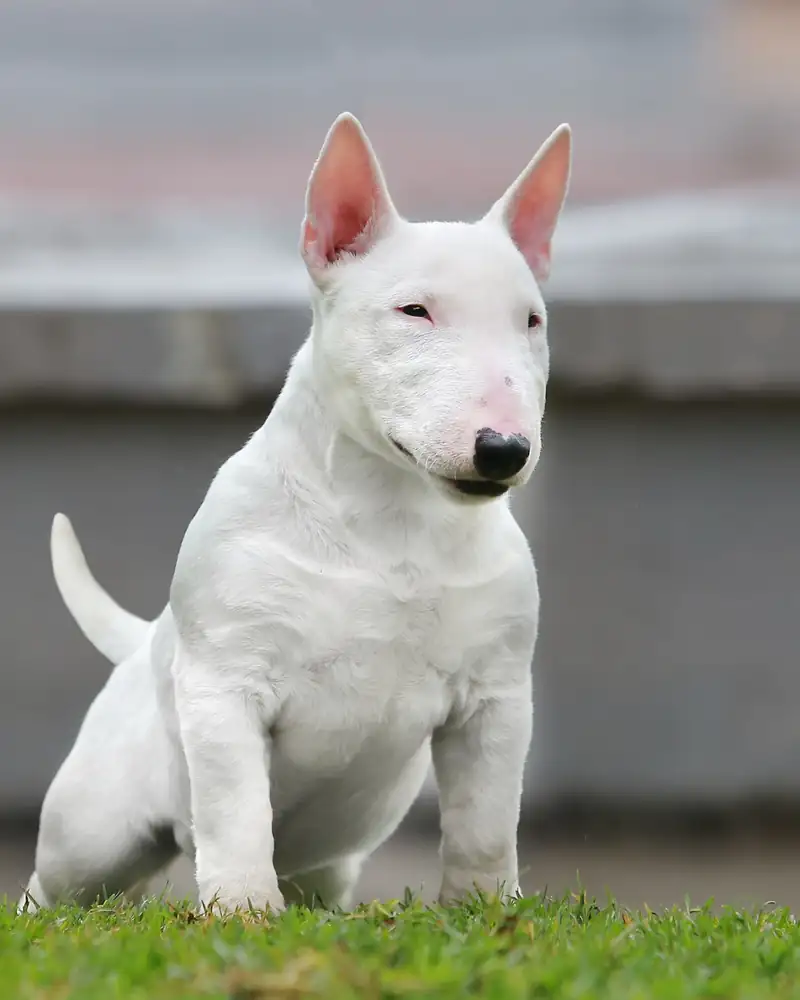
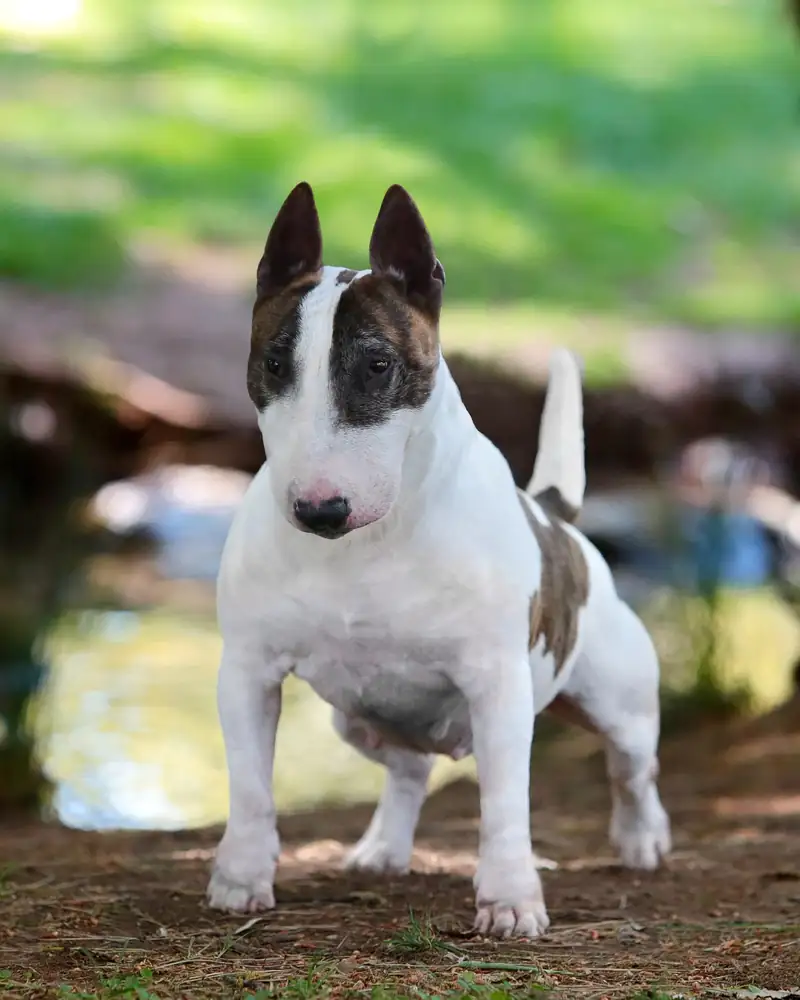
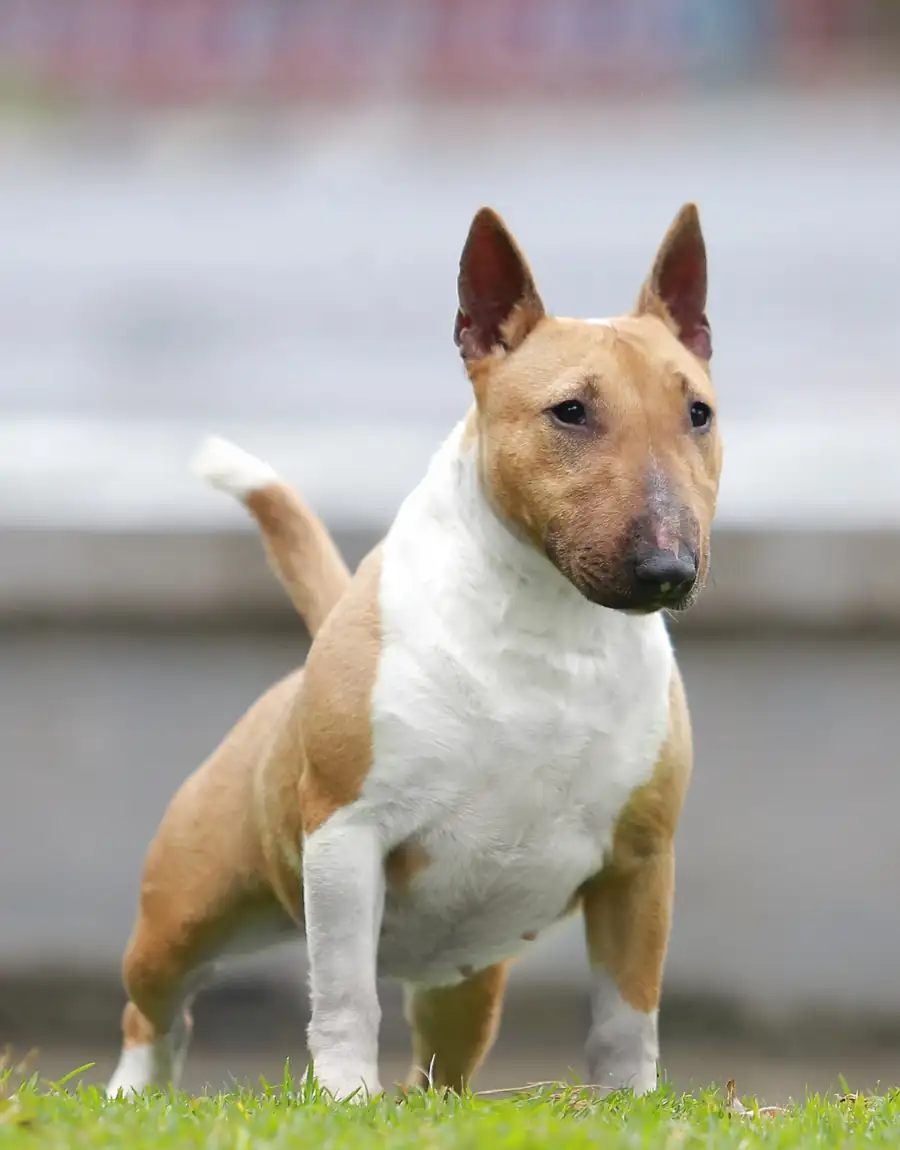
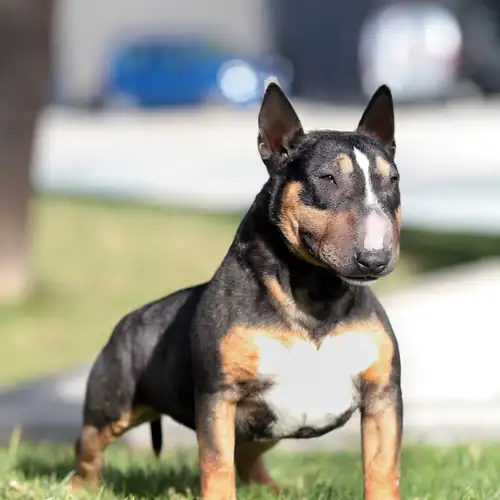
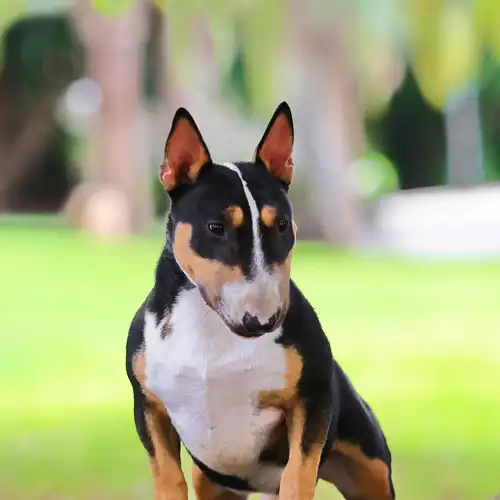
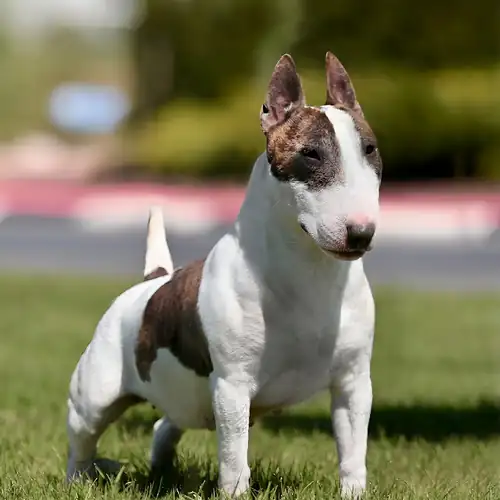
Captions describe how the coat looks in the photo. We confirm each dog's registered colour on the video call.
Hoping for a colour?
Tell us on the waiting list
We'll be honest about what's coming in the next litters, and about the puppy that suits your home best, whatever its colour. Joining the list costs nothing.
See the waiting listFAQ
What colours do miniature bull terriers come in?
Two varieties: white, and coloured. Whites have a pure white coat, and markings on the head are allowed. In coloured dogs colour predominates: brindle is preferred, and black brindle, red, fawn and tricolour are acceptable under the FCI standard. Blue and liver are highly undesirable.
What is the rarest miniature bull terrier colour?
There is no official ranking. Be careful with sellers who advertise "rare" colours such as merle, lilac, chocolate or blue: the UK Miniature Bull Terrier Club says these don't occur naturally in the breed and are introduced by crossing with other breeds.
Do white miniature bull terriers go deaf?
Most hear normally, but white coats are linked to a higher risk of congenital deafness. A study of bull terriers found white dogs were more likely than coloured ones to be deaf. Coloured dogs can be deaf too, so ask for a BAER hearing test for both parents and, ideally, the puppy.
At what age can a puppy have a BAER test?
The OFA accepts BAER results from 35 days of age, and the UK Miniature Bull Terrier Club suggests testing a litter at around 5½ to 6½ weeks. The test is done once in a dog's lifetime and passes only if the dog hears in both ears.
Is a white mini bull with a coloured patch on its head a white?
Yes. The FCI and Kennel Club standards say markings on the head are not penalised in whites, and the UK club lists white with brindle, black brindle, black and tan, red or fawn head markings as approved. The body coat is what defines a white.
Are brindle miniature bull terriers calmer than white ones?
No standard or study we know of links temperament to coat colour. The FCI standard describes one temperament for the whole breed. Differences in character are between individual dogs, so choose on temperament and health first, and colour last.
Sources
- FCI, Standard no. 359, Miniature Bull Terrier (PDF, 05.07.2011)
- Royal Kennel Club, Bull Terrier (Miniature) breed standard
- AKC, Official standard of the Miniature Bull Terrier (PDF)
- UKC, Miniature Bull Terrier breed standard
- Miniature Bull Terrier Club (UK), Approved colours, Deafness and Liver colour in bull terriers (Carl Pew)
- Miniature Bull Terrier Club of America, Health issues
- OFA, Congenital deafness
- Strain GM. Deafness prevalence and pigmentation and gender associations in dog breeds at risk. The Veterinary Journal, 2004;167(1):23-32.
General information about the breed, not veterinary advice. For questions about a specific dog's hearing or skin, talk to your vet.